HIPAA Compliant Chatbot: Build a Medical AI Chat Safely

Emma Ke
on April 5, 2024CMO
8 min read
HIPAA Compliant Chatbot: Short Answer
A HIPAA compliant chatbot is not just a chatbot with medical wording. The full deployment must protect PHI through a BAA where required, secure transmission, access controls, auditability, retention controls, and safe escalation for clinical or patient-safety issues.
For healthcare teams, the safest architecture is privacy-first: keep Chat Data conversation storage off unless you need transcripts in the dashboard, send required logs to your own HIPAA-compliant system through secure webhooks, limit PHI sent to models, and keep humans in the loop for diagnosis, treatment, billing disputes, and urgent symptoms.
Overview
The integration of Artificial Intelligence (AI) into healthcare is not just a futuristic concept but a present reality that's reshaping patient care, medical diagnostics, and the overall efficiency of the healthcare industry. AI's potential in healthcare is huge, providing significant advantages in different areas from clinical decision support to operational efficiencies and even patient monitoring.
A report from McKinsey emphasizes the possibility of AI becoming a crucial part of the healthcare value chain, enhancing clinical practice with evidence-based clinical decision-making tools. The report predicts a future where AI's role in healthcare is extended, backed by wider data integration, improved data quality through strict governance, and growing trust in AI solutions from healthcare professionals and patients alike [McKinsey & Company].
One of the most impactful parts of AI in healthcare is its ability to enhance the workforce. Despite common fears, the automation potential within healthcare is quite low, with only 35% of tasks considered automatable. This creates an opportunity for AI to ease workforce shortages rather than substitute human jobs. The World Health Organization predicts a significant rise in the need for healthcare workers, indicating that automation could help fill this gap, especially in nursing and home health aide positions [McKinsey & Company].
Furthermore, AI tools have displayed potential in various crucial areas: forecasting patient health paths, streamlining operational procedures, and automating routine tasks, thus lessening the administrative load on healthcare providers. However, these progressions bring about difficulties like data accessibility, bias, scalability, transparency, privacy, and liability issues, which need to be carefully addressed to fully utilize AI's advantages [US GAO].
Why Must Medical Chatbots Be HIPAA Compliant?
Ensuring HIPAA compliance for medical chatbots is paramount due to the sensitive nature of healthcare data. The Health Insurance Portability and Accountability Act (HIPAA) sets the standard for protecting sensitive patient data. When dealing with AI tools, including medical chatbots, it's crucial to navigate challenges like data access, bias, and privacy to safeguard patient information effectively [US GAO].
A major challenge is obtaining high-quality data needed for creating efficient AI tools, along with the risk of bias in the data utilized. Such biases can reduce the safety and effectiveness of AI tools across various patient groups, resulting in differences in treatment outcomes [US GAO]. Furthermore, the incorporation of AI tools into different environments is filled with difficulties due to institutional variations and patient population diversity, emphasizing the significance of scalable and flexible solutions that adhere to HIPAA standards.
The rise of AI in healthcare offers a hopeful path for improving patient care and operational efficiency. Yet, the implementation of medical chatbots needs to be approached with a strong understanding of HIPAA compliance to safeguard patient privacy and ensure the fair efficiency of AI-driven healthcare solutions. As the technology continues to evolve, so too must our approaches to integrating these tools into healthcare practices, always with an eye towards ethical standards and data protection.
Chat Data’s Commitment to HIPAA Compliance
Chat Data leads in offering HIPAA-compliant medical chatbot solutions, guaranteeing the confidentiality and authenticity of patient conversations through various key measures:
Chat Data’s HIPAA Compliant Business Associate Agreement (BAA) with OpenAI
In the realm of healthcare, where patient confidentiality is paramount, Chat Data has positioned itself as a leader by entering into a HIPAA Compliant Business Associate Agreement (BAA) with OpenAI. This important partnership is not just a formality but a strong commitment to safeguarding patient data. A BAA is a legally binding paper that details the duties of both parties in managing protected health information (PHI) in line with HIPAA rules. For customers on the Standard plan or above with a signed customer BAA, this contract covers API calls made using Chat Data's organizational ID. This includes stringent safeguards to prevent the use of chat data in any form of model retraining by OpenAI, thereby securing patient privacy. For clients and users seeking to understand the depth and breadth of this agreement, Chat Data provides transparency and encourages review of the contract details, reinforcing its dedication to trust and security in patient data handling.
Distributed Rag Knowledge Base
Chat Data's innovative approach to creating a distributed rag knowledge base by condensing over 50GB of medical knowledge into a precise, accessible format represents a groundbreaking stride in healthcare technology. This method allows Chat Data’s chatbots to tap into a wealth of medical information without the risk of exposing personal patient information (PII). The distributed nature of the knowledge base ensures that responses are pulled from a broad spectrum of medical content, yet remain focused and relevant to the user's inquiries. This structure not only enhances the chatbot's efficiency in providing accurate medical advice but also strengthens the privacy and security of patient data by making sure that the basis of responses is completely free of PII. Such a knowledge base is a testament to Chat Data's commitment to leveraging technology for enhanced healthcare delivery while upholding the highest standards of data privacy.
Privacy-first Conversation Handling
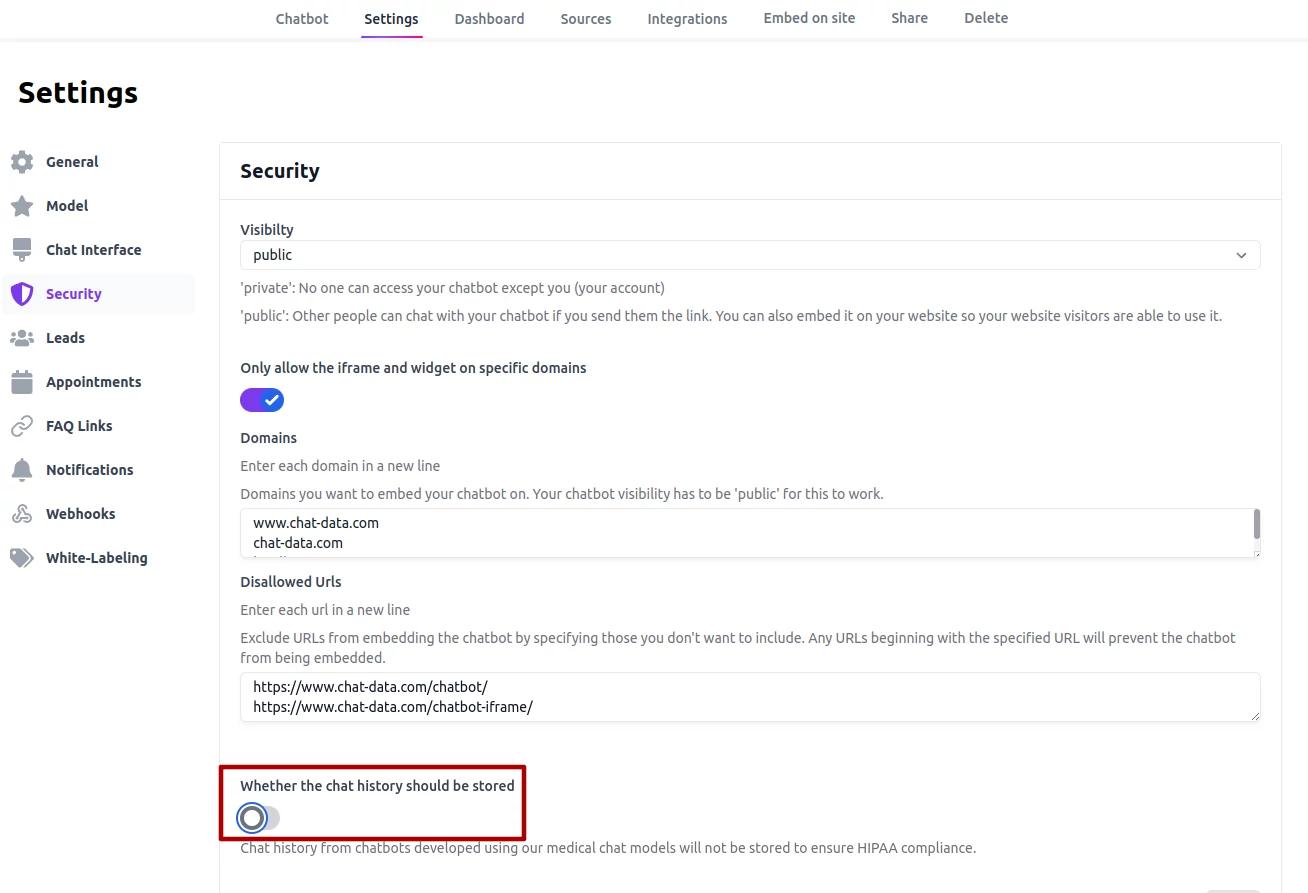
Chat Data gives healthcare teams control over conversation retention. Chat history storage starts on by default for every model, including medical-chat-human, medical-chat-vet, and custom medical agents, and can be disabled under the chatbot's Privacy settings, in the "User Privacy & Storage" section. Webhooks let you stream chat events to your own HIPAA-compliant storage when your policy requires a separate system of record. If an operator uses live-chat lifecycle controls such as assigning, snoozing, resolving, or taking over an active session, Chat Data may materialize that session into the dashboard so the workflow has a conversation record to update. Treat the storage toggle and your live-chat process together when deciding where PHI should be retained.
Crafting Your HIPAA-Compliant Medical Chatbot
Creating a HIPAA-compliant medical chatbot with Chat Data is a straightforward process:
Registration and Setup
Begin by registering for a Chat Data account. The registration process necessitates only an email address and password for account creation.
Initiate Chatbot Creation
Access your Chat Data account by logging in. From there, click the My Chatbots section via the navigation header, or alternatively, click the Build Your Chatbot button located on the homepage. Upon redirection to the designated My Chatbots page, proceed by clicking the New Chatbot button, thereby initiating the chatbot creation process.

Model Selection
Choose the medical-chat-human model to utilize our pre-trained Medical Chat model tailored exclusively for human medical issues — the same model behind our AI doctor chat and AI symptom checker. This model is trained on a diverse dataset, including insights from hundreds of professional medical books, Merck manuals, and databases of professional medical decisions. The training data is enriched with information sourced from authoritative publications such as professional medical articles from the National Institutes of Health (NIH). Presently, this model is actively serving over 3000 users on the Medical Chat platform. Chat history storage starts on by default for this model and can be disabled under your chatbot's Privacy settings, in the "User Privacy & Storage" section.
You can also create a custom chatbot using your curated medical knowledge base and turn off the chat history storage in the User Privacy & Storage section of the Privacy settings tab.
Webhook Setup (Optional)
If your organization needs its own HIPAA-compliant system of record, follow the Webhooks Setup guide to transmit chat events to storage you control. Chat Data webhooks are best-effort delivery hooks, not a durable acknowledged queue: a process exit or repeated endpoint failure can leave a gap. Use them to feed a storage system you operate, and add your own durable intake, acknowledgements, monitoring, and replay path before treating that feed as required compliance evidence. Chat Data's dashboard can also retain conversations when chat-history storage is enabled, and live-chat lifecycle actions can create dashboard records for active sessions, so do not rely on Chat Data as a strict non-retention boundary.
Integration and Deployment
Seamlessly embed your chatbot on your website or integrate with third-party channels following the guide in Integrating Custom GPTs into Your Website: A Comprehensive Guide and API Guide. Exercise caution with third-party platforms that may not meet HIPAA standards and conduct thorough research to ensure compliance.
Summary
Enter the future of healthcare with Chat Data, where advanced technology meets strict privacy criteria. To see the medical AI in action before building your own, try the AI doctor chat or ask a doctor a question free. Welcome the strength of HIPAA-compliant medical chatbots to improve patient care, simplify operations, and guarantee unmatched privacy and security. Using Chat Data, you're not only embracing a tool; you're transforming how you interact with and assist your patients—effectively, securely, and compassionately.
Begin your transformative journey and unlock the potential to engage with your patients anytime, anywhere, without ever compromising on privacy. Experience the difference firsthand and see how Chat Data can redefine your approach to healthcare.
Dive into the world of seamless and secure medical consultations with a free trial today.
Frequently Asked Questions
Are medical chatbots HIPAA compliant?
A medical chatbot is HIPAA compliant only when the full deployment meets HIPAA requirements: BAA coverage where required, PHI safeguards, access controls, auditability, secure transmission, retention controls, and human oversight for clinical risk. A generic chatbot is not automatically HIPAA compliant.
How do you choose a HIPAA compliant chat API?
Choose a HIPAA compliant chat API by checking BAA availability, encryption, PHI retention behavior, audit logs, access controls, webhook security, model-data usage terms, and whether the system supports human escalation for medical or patient-safety issues.