AI Shopping Bots Explained: What They Are and How Stores Use Them in 2026

Emma Ke
on July 16, 2026CMO
8 min read
AI Shopping Bots Explained: What They Are and How Stores Use Them in 2026
Search for "shopping bot" and you will find two completely different technologies wearing the same name. One is a piece of consumer software that races through checkout pages to snatch limited-edition sneakers before humans can click "buy." The other is a merchant-side AI assistant that greets shoppers on a store, answers product questions, tracks orders, and rescues abandoned carts.
Confusing the two is easy — and expensive. Retailers spend real money blocking the first kind while deploying the second. This guide untangles both meanings, explains how each works in 2026, and shows store owners how to launch an AI shopping assistant without writing a line of code.
The Two Meanings of "Shopping Bot"
| Consumer buying bots | Merchant AI shopping assistants | |
|---|---|---|
| Who runs it | Individual resellers and scalpers | The store itself |
| Goal | Buy scarce products faster than humans | Help shoppers buy, answer questions, reduce support load |
| Examples | Sneaker bots (Cybersole, Kodai), ticket bots | Store chatbots and AI sales agents |
| Retailer stance | Actively blocked | Actively deployed |
| Legality | Ticket bots banned by the US BOTS Act; others usually violate terms of service | Ordinary, legal business software |
When marketers say "shopper bot," "buying bot," or "purchasing bot," they usually mean the consumer-side kind. When ecommerce teams talk about shopping bots in 2026, they almost always mean the merchant-side assistant. The rest of this article covers both — starting with the one making headlines for the wrong reasons.
Consumer Buying Bots: The Bots Stores Fight
A consumer buying bot (or purchasing bot) automates the entire checkout flow: it monitors product pages, adds items to the cart the millisecond they drop, autofills payment details, and completes checkout across dozens of accounts and proxy IP addresses simultaneously. Sneaker drops, graphics cards, concert tickets, and game consoles are the classic targets.
This is a genuine paid industry. Cybersole, one of the best-known sneaker bots, retails at £300 with a £100 renewal every six months — and because licenses sell out, resale access runs around $150/month. Kodai retails at $175 for the first two months, then $59.99/month. Users also pay for residential proxies and virtual credit cards on top.
Are they legal? In the US, the BOTS Act specifically outlaws bots that circumvent ticket-purchase controls, but there is no equivalent federal ban on sneaker or retail buying bots. That said, they violate virtually every retailer's terms of service, and stores respond with bot-detection vendors, raffle-based releases, and order cancellations.
The scale of the problem keeps growing. According to the 2026 Imperva Bad Bot Report, automated traffic now accounts for more than 53% of all web traffic, and bad bots alone generate 40% of it — up three percentage points year over year, driven heavily by AI-powered automation.
If you run a store, the takeaway is simple: this kind of shopping bot is a threat to inventory fairness, not a tool to adopt. The kind you should adopt is the opposite one.
Merchant-Side AI Shopping Assistants: The Bots Stores Deploy
A merchant-side shopping bot is an AI assistant, trained on your own catalog and policies, that talks to shoppers wherever they are — your website, WhatsApp, Instagram, or Facebook Messenger. In 2026 these are LLM-powered agents rather than the rigid decision-tree chatbots of a few years ago, which means they handle free-form questions ("does this jacket run small?", "where is my order?") instead of forcing shoppers through canned menus.
The commercial case rests on one stubborn number: Baymard Institute's running average puts cart abandonment at 70.22% across ecommerce — a figure that has barely moved since 2020. Much of that loss traces to answerable friction: surprise shipping costs, unclear return policies, and unanswered product questions at the moment of decision. An assistant that resolves those questions in seconds attacks abandonment at its root.
What an AI shopping assistant actually does
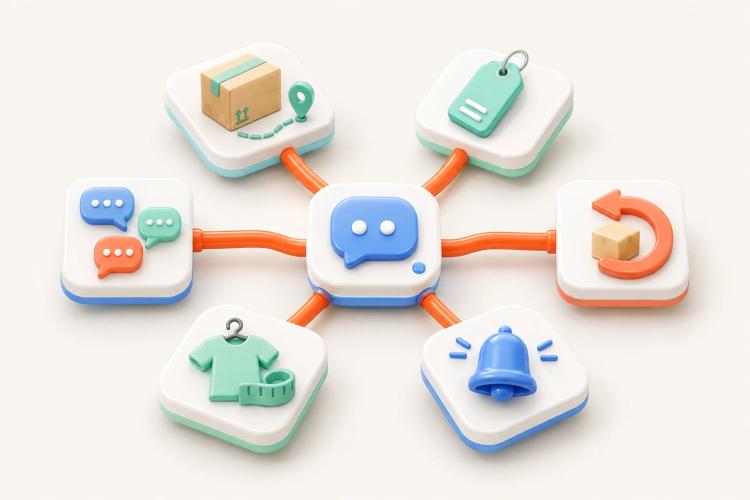
1. Product discovery. The assistant knows the catalog. A shopper describes what they need ("waterproof trail shoes under $120 in size 10") and the bot narrows options, links directly to product pages, and answers comparison questions. This turns search-and-filter drudgery into a conversation.
2. Pre-purchase objection handling. Questions about sizing, materials, compatibility, shipping times, and return policies get instant answers drawn from your actual policy pages — at the exact moment hesitation would otherwise become an abandoned tab.
3. Order tracking and post-purchase support. "Where is my order?" is the single most common ecommerce support ticket. A bot connected to your store data answers order-status, shipping, exchange, and return questions automatically, around the clock.
4. Cart recovery. When a shopper stalls at checkout or returns after abandoning a cart, the assistant can proactively answer the question that stopped them and route genuinely stuck cases to a human. Because the AI resolves the routine majority, your team's live-chat time concentrates on conversations that actually need a person.
5. Escalation to humans. Good assistants know their limits. When a shopper asks for something outside the bot's knowledge — or simply asks for a person — the conversation hands off to a live agent with the full chat history attached.
How to Launch One Without Code
You do not need a developer to deploy a merchant-side shopping bot in 2026. The no-code path looks like this:
- Connect your store. Platforms like Chat Data offer direct Shopify and WooCommerce integrations that import product details, FAQs, and support policies from your store.
- Train on your policies. Add your shipping, returns, and sizing pages so the assistant answers from your real rules rather than guessing.
- Deploy to your channels. Embed the widget on your storefront, then connect the same bot to WhatsApp, Instagram, Messenger, Telegram, LINE, Slack, or Discord — one brain, every channel.
- Set escalation rules. Decide when conversations route to your team, and let the AI absorb the rest.
For a broader look at what this unlocks across the funnel, see our guide to chatbots for ecommerce.
Comparing merchant-side shopping bot platforms (July 2026)
| Platform | Starting price | Pricing model | Notes |
|---|---|---|---|
| Chat Data | Free; paid from $19/mo | Flat plans with message credits | AI-native agents, Shopify/WooCommerce integrations, 8+ chat channels, workflow automation, live-chat escalation |
| Tidio (Lyro AI) | Lyro from $39/mo (50 conversations) up to $289/mo (500) | Per-conversation, metered separately from the base plan | Mature live-chat suite; AI conversations are a separate meter on top of the plan |
| Gorgias AI Agent | Tickets from $10/mo (50 tickets); AI resolutions ~$1 each | Per-ticket plus per-automated-resolution | Strong Shopify helpdesk; AI Agent features are Shopify-only, and AI-resolved tickets incur both fees |
| Rep AI | From ~$79/mo | Visitor/session-based, ~$12 per 1,000 visitors beyond plan | Proactive sales-focused assistant for Shopify; costs scale with traffic spikes |
Each of these is a credible choice. Tidio and Gorgias are strongest if you are primarily buying a helpdesk and adding AI to it; Rep AI leans hardest into proactive selling on Shopify. Chat Data's differentiators are flat, predictable pricing (no per-resolution fees), the breadth of channels one bot can serve, and built-in workflow automation for multi-step processes like returns or lead routing.
Real Use Cases
- Fashion and apparel: sizing and fit questions answered from size charts; "complete the look" recommendations from the catalog.
- Electronics: compatibility checks ("does this lens fit my camera body?") that would otherwise become support tickets or lost sales.
- Food and beverage: allergen and ingredient questions, subscription management, delivery-window queries.
- Cross-border stores: multilingual support without hiring multilingual agents — the assistant answers in the shopper's language.
- High-SKU catalogs: guided discovery that surfaces the right product from thousands, faster than faceted search.
Frequently Asked Questions
What is a shopping bot?
A shopping bot is software that automates part of the buying or selling process online. The term covers two very different tools: consumer-side buying bots (like sneaker bots) that automate checkout to grab limited-stock products, and merchant-side AI shopping assistants that help a store answer product questions, track orders, and recover abandoned carts.
Are shopping bots legal?
It depends on the type. In the US, the BOTS Act specifically outlaws bots that bypass ticket-purchase limits, but there is no equivalent federal ban on sneaker or retail buying bots. However, buying bots almost always violate retailer terms of service, and stores actively block them. Merchant-side AI shopping assistants are ordinary business software and are fully legal.
How do AI shopping assistants increase sales?
AI shopping assistants answer pre-purchase questions instantly, recommend products from the catalog, resolve shipping and return concerns at the moment of hesitation, and hand complex cases to a human agent. Removing friction at these decision points helps reduce cart abandonment, which averages 70.22% across ecommerce according to Baymard Institute.
Can I add a shopping bot to my store without coding?
Yes. No-code platforms like Chat Data let you train an AI shopping assistant on your product catalog and policies, then deploy it on Shopify, WooCommerce, or any website with a small embed script. You can also connect the same bot to WhatsApp, Instagram, and Facebook Messenger without writing code.
How much does a merchant-side shopping bot cost?
Entry pricing in 2026 ranges widely. Chat Data starts free with paid plans from $19/month. Tidio prices its Lyro AI agent from $39/month for 50 conversations, Gorgias charges per ticket plus roughly $1 per AI-automated resolution, and Rep AI uses visitor-based pricing that starts around $79/month and scales with traffic.
Conclusion
"Shopping bot" describes both a problem and a solution. The consumer-side buying bots that scalp sneakers and consoles are an arms race most stores can only defend against. The merchant-side AI shopping assistant, by contrast, is one of the highest-leverage tools a store can deploy in 2026: it answers the questions that cause 70% of carts to be abandoned, works every channel your customers already use, and costs less per month than a single hour of agency time.
If you run a Shopify or WooCommerce store, you can start free with Chat Data, train an assistant on your catalog this afternoon, and see what it deflects — and converts — within a week.
Frequently Asked Questions
What is a shopping bot?
A shopping bot is software that automates part of the buying or selling process online. The term covers two very different tools: consumer-side buying bots (like sneaker bots) that automate checkout to grab limited-stock products, and merchant-side AI shopping assistants that help a store answer product questions, track orders, and recover abandoned carts.
Are shopping bots legal?
It depends on the type. In the US, the BOTS Act specifically outlaws bots that bypass ticket-purchase limits, but there is no equivalent federal ban on sneaker or retail buying bots. However, buying bots almost always violate retailer terms of service, and stores actively block them. Merchant-side AI shopping assistants are ordinary business software and are fully legal.
How do AI shopping assistants increase sales?
AI shopping assistants answer pre-purchase questions instantly, recommend products from the catalog, resolve shipping and return concerns at the moment of hesitation, and hand complex cases to a human agent. Removing friction at these decision points helps reduce cart abandonment, which averages 70.22% across ecommerce according to Baymard Institute.
Can I add a shopping bot to my store without coding?
Yes. No-code platforms like Chat Data let you train an AI shopping assistant on your product catalog and policies, then deploy it on Shopify, WooCommerce, or any website with a small embed script. You can also connect the same bot to WhatsApp, Instagram, and Facebook Messenger without writing code.
How much does a merchant-side shopping bot cost?
Entry pricing in 2026 ranges widely. Chat Data starts free with paid plans from $19/month. Tidio prices its Lyro AI agent from $39/month for 50 conversations, Gorgias charges per ticket plus roughly $1 per AI-automated resolution, and Rep AI uses visitor-based pricing that starts around $79/month and scales with traffic.